
What is an online record of field work?
An online record is the record of a field job (a dive, an ROV inspection, a treatment bath, a net cleaning) made on a tablet or a phone at the time and place it happens, and stored on a platform where the company and its client consult it without writing it again.
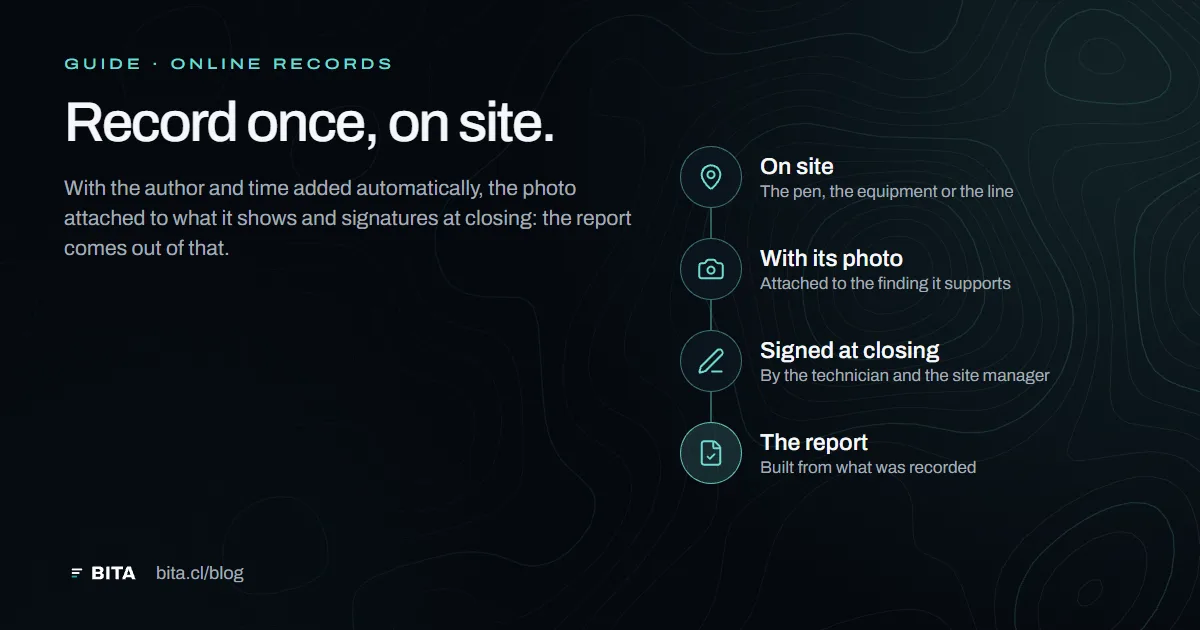
What sets it apart from the field notebook is not the screen: it is that the data is written once. What the technician records at the pen is what the office sees, what goes into the report and what stays in that asset's history. There is no second copy to transcribe and, therefore, no second place to get it wrong.
“Online” does not mean “with signal”. At a farm site or on the deck of a barge, coverage fails, and a record that needs a connection to save is a record that gets lost. The record is saved on the device first and uploads by itself when the signal returns.
From paper to online records: what changes
Seven things done today with a notebook, a spreadsheet and a WhatsApp group, and how they look with an online record:
- Where it is writtenOn paper: on deck, and again at the office when it goes into the spreadsheet. Online: once, on the tablet, where the work happens.
- WhenOn paper: the technician writes the date and time, sometimes at the end of the day. Online: the system sets them at the moment of the record, and they cannot be edited.
- PhotosOn paper: they arrive by WhatsApp or in a folder, without saying what they support. Online: each photo is attached to the finding, pen or measurement it proves, with its time.
- SignaturesOn paper: on a separate sheet that gets scanned or lost. Online: the technician and the site manager sign on the same screen, and the signature stays in the record.
- The reportOn paper: assembled in Word from the spreadsheet, a day or two later. Online: it comes from the record the same day, with the company's brand, its number and its signatures.
- The historyOn paper: the previous inspection of the same pen is in another file, if someone finds it. Online: each record hangs from its asset, and today's inspection is compared with the last one.
- Who sees itOn paper: whoever has the file. Online: each person in the company according to their role, and the client only the issued reports, in their portal.
What an online record needs to count as evidence
A shared spreadsheet in the cloud is also “online”. What makes a record count as evidence before a client, an auditor or an authority is this:
- A number and a work orderEach record hangs from an order with a number that is unique in the company. That says which job it belongs to, for which client and at which site.
- Author, date and time set by the systemWho recorded and when is written by the platform, not the person. A date that can be corrected by hand proves nothing.
- The exact assetThe pen, the mooring line, the equipment or the tank, chosen from the site's list and not written from memory: “104” and “pen 104” have to be the same thing.
- Evidence attached to the dataThe photo, the measurement or the ROV capture next to the finding it supports, with its time. A loose photo in a folder is evidence of nothing in particular.
- Capture without signalSaved on the device first and uploaded when there is coverage. Nothing is deleted from the device until the platform confirms it received it.
- The signatures of those responsibleWhoever did the work and, when it applies, whoever received it, in the same record.
- Lists instead of free textProducts, technicians, barges and diagnoses are chosen from a master list. Typed by hand on deck, the same name ends up spelled three ways and can no longer be filtered or compared.
- Versions, not deletionWhat is issued is not edited quietly. A correction is a new version with its reason; the previous one stays archived and the document can be verified with a code.
- Your data, exportableEverything recorded can be downloaded in Excel, in full. A record you can only see inside an application is a record you depend on.
The case of diving: the supervisor's logbook
In Chile, the professional diving regulation of the Maritime Authority (TM-035) requires the supervisor to keep a logbook of every dive (depth, time and decompression schedule) in the official format set by the Directorate General. An online record of the job does not replace that logbook as long as the authority does not accept a digital format.
What the online record does is carry what the logbook does not: what was found in each pen, with which photo, in what condition, and the report the farm site expects the same day. They are two documents with two purposes: the logbook answers for the diver's safety before the authority; the record, for the work done before the client.
Law 21.789, of 2026, creates the special diving contract in the Labour Code: it regulates the employment relationship of divers, not the format of their records. Before believing any vendor, BITA included, that its digital logbook “is legally valid”, it is worth asking which Maritime Authority resolution it relies on.
What it looks like in each service
- DivingEvery dive pen by pen: findings with photo, condition and criticality, and the report for the salmon farmer the same day.
- ROVOne record per day and site: mortality extraction with before-and-after photos, net and predator-net inspection by face and depth, upwelling by disc.
- Treatment bathsDose, exposure time, oxygen and efficacy of each pen, captured on deck without signal and signed by the site manager.
- Net cleaningEach session with its cleaned faces, square metres, passes and hour meter; from there come the efficiency per hour and the status of each net.
- MooringsThe six-monthly inspection of each line, from buoy to anchor, with its numbered captures and a status per line.
- LaboratoryEach sample with its chain of custody, from collection to result, and a tracking code for the client.
How to leave paper without stopping the operation
- Start with one serviceThe one that issues the most reports or causes the most trouble with the client. One, not all: the team learns with one form, not ten.
- Load the master lists before day oneClients, sites with their pens, technicians, barges and products. Whatever the technician has to type by hand on deck is what will not match later.
- Make the form today's paperThe same fields, in the same order. A record that asks for more than the paper gets half filled; what is missing is added later.
- Two weeks in parallelPaper and tablet at the same time. Compare the reports: if the platform's comes out the same or better, the paper is no longer needed.
- Turn off the paper when the report comes out by itselfThe day the report is issued from the record without anyone assembling it at the office, the change is done.
How BITA does it
BITA is a traceability platform for companies that work in the field. What this guide asks for is part of everyday work:
- One record per serviceDiving, ROV, baths, net cleaning, moorings, maintenance, training, laboratory and vaccination, each with its job's form and its master lists.
- Without signal, on deckTreatment baths, training records and maintenance reports are saved on the tablet and upload by themselves when coverage returns.
- The report comes from the recordWith the company's brand, its number, its signatures and a QR code; the client receives it the same day and verifies it without an account.
- Your data is yoursEverything recorded is downloaded in Excel from Reports, complete and historical, and every report as a PDF.
