
The second shift
The second shift is the admin work left after finishing in the field: typing up the notes, sorting the photos and putting the report together. It is almost always done after hours, and almost never measured.
The diver surfaces, the ROV returns to the boat, the technician packs up. On site the job is done; back at the company another one starts. The notes are in a wet notebook or on a phone, the photos on three different phones, and the client expects the report tomorrow.
So someone —the same technician, the supervisor or someone at the office— sits down to rebuild the day: which pen is in this photo, how deep the tear was, who signed. It is work that never shows up in the quote or the schedule, and so nobody counts it.
How much time goes into paperwork?
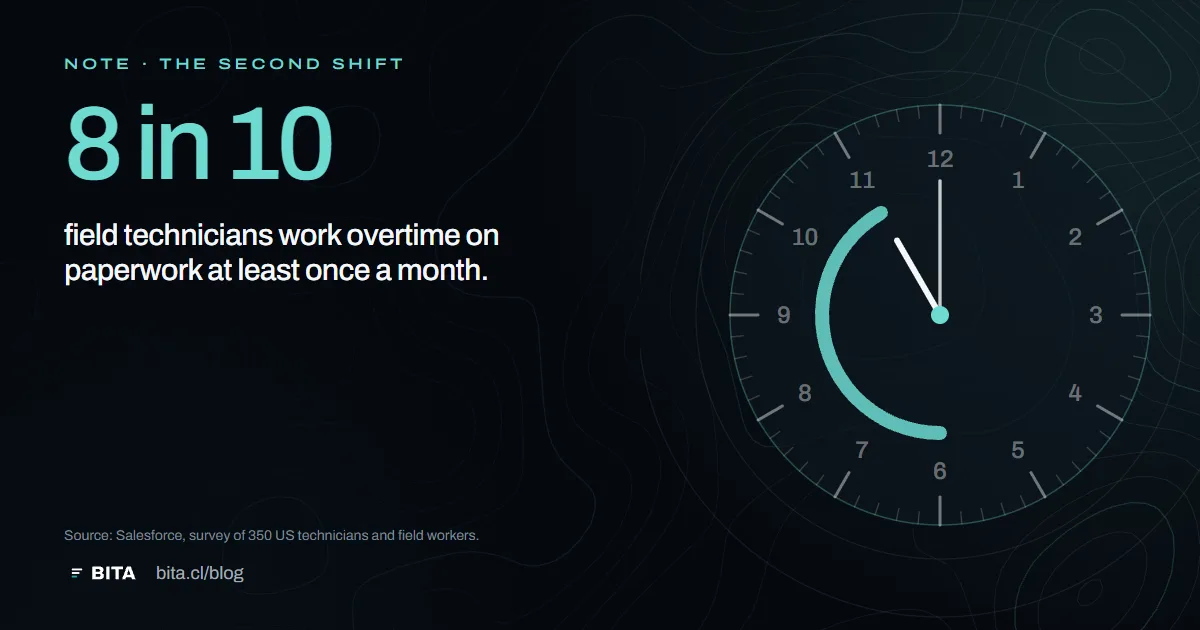
In a Salesforce survey of 350 technicians and field workers in the United States, 81% said they work overtime on administrative tasks at least once a month.
- 30% of the workday on admin tasksAgainst 28% delivering the service: paperwork already weighs more than the work that gets paid.
- More than 7 hours a weekOn low-value tasks such as data entry or summarising completed jobs: nearly a full working day every week.
- 37% say it keeps them from workingMore than a third of those surveyed say administrative tasks prevent them from doing their job.
These are US figures, across a range of trades (installation, maintenance, inspection), published by a company that sells software for field technicians: they should be read with that in mind. We found no equivalent study for Chile or for aquaculture. But anyone who has put together a job report at eleven at night will recognise the pattern.
What Chilean law says about those hours
If the report is finished outside the agreed working hours and the employer knows it, those hours are overtime even without a written agreement, and they are paid at a premium of at least 50%.
Chile's Labour Code defines overtime as time worked beyond the legal maximum or the agreed working hours, if lower (article 30). Overtime may only be agreed to meet temporary needs or situations of the company, in writing, for up to three months and a maximum of two hours a day (articles 31 and 32).
The Labour Directorate (Dirección del Trabajo) has ruled that the lack of that agreement does not release the employer from paying: hours worked beyond the working day with the employer's knowledge are overtime and must be paid, even though working them without an agreement is also a breach (Ord. No. 771, 2024).
And since 26 April 2026 the maximum working week is 42 hours; on 26 April 2028 it will drop to 40 (Law 21,561). Every hour spent rebuilding a report weighs more than before. We explain it in the 42-hour week in field work.
This applies to people with set working hours: article 22 exempts some positions from that limit. It is general information, not legal advice; for a specific case, ask the Labour Directorate or your lawyer.
Where does all that time come from?
Most of it does not go into writing: it goes into rebuilding.
- Everything is recorded twiceOnce in the field —the notebook, the spreadsheet, the voice note— and again at the office, when it is copied into the report format.
- Photos arrive looseOver WhatsApp, without saying which pen, piece of equipment or point they show. You have to guess or ask, and asking means waiting.
- The report is built by handCopy the previous one, change the dates, paste the photos, fix the tables. Every report is a document laid out from scratch.
- Signatures have to be chasedPrint, sign, scan and send it back, or wait for the site manager to answer the email.
- Corrections happen by emailThe client asks for a change and a version 2 appears, then a final version and a «final-final». Nobody knows which one is current.
How to win those hours back
The way to shorten the second shift is not to have one: record once, in the field, and let the report come out of that record.
- Record on site, onceWhat you see is noted right there, with the time and the author added automatically. Without signal, the record is kept on the device and uploaded later.
- The photo attached to what it showsEach photo is taken from the finding, the pen or the point it supports, not from the gallery. That way it never arrives loose.
- Sign when the job closesThe technician and the site manager sign on screen before leaving, not three days later.
- Let the report come out of the recordIn a fixed format built from the captured data. The report stops being a document someone writes and becomes a view of what was recorded.
- Correct with versions, not with emailsIf something has to change, the record is corrected and a new version is issued, labelled as such; the previous one is kept.
That is what an online record of field work does, and it is why we built BITA. But the principle works with any tool: as long as the report is written afterwards, the second shift does not go away.
Measure it before changing anything
The number that matters is yours. For two weeks, write down two times for every job: when the field work ended and when the report went to the client. And ask how many of those hours were worked outside the working day.
With that number you can decide on data: what each report costs today, how much is paid in overtime —or worked unpaid— and how much it is worth investing to change it.
Sources
- Salesforce, «Tradespeople, Techs Waste Nearly a Full Day's Work Weekly on Paperwork», 9 April 2025. Survey of 350 US field workers.
- Dirección del Trabajo, Ord. No. 771, 19 November 2024: overtime without a written agreement (in Spanish).
- Dirección del Trabajo: the overtime premium (in Spanish).
- Library of the National Congress: Law 21,561, reducing the working week to 40 hours (in Spanish).
