
What is a field service report?
A field service report is the document that tells what was done in a field job, what was found and what is recommended, with the evidence behind it and the signature of whoever is accountable.
It is issued by the company that did the work —an inspection, a maintenance job, a service— and read by someone who was not there: the client, their management, an auditor or the company doing the next job. So it has to stand on its own, with nobody there to explain it.
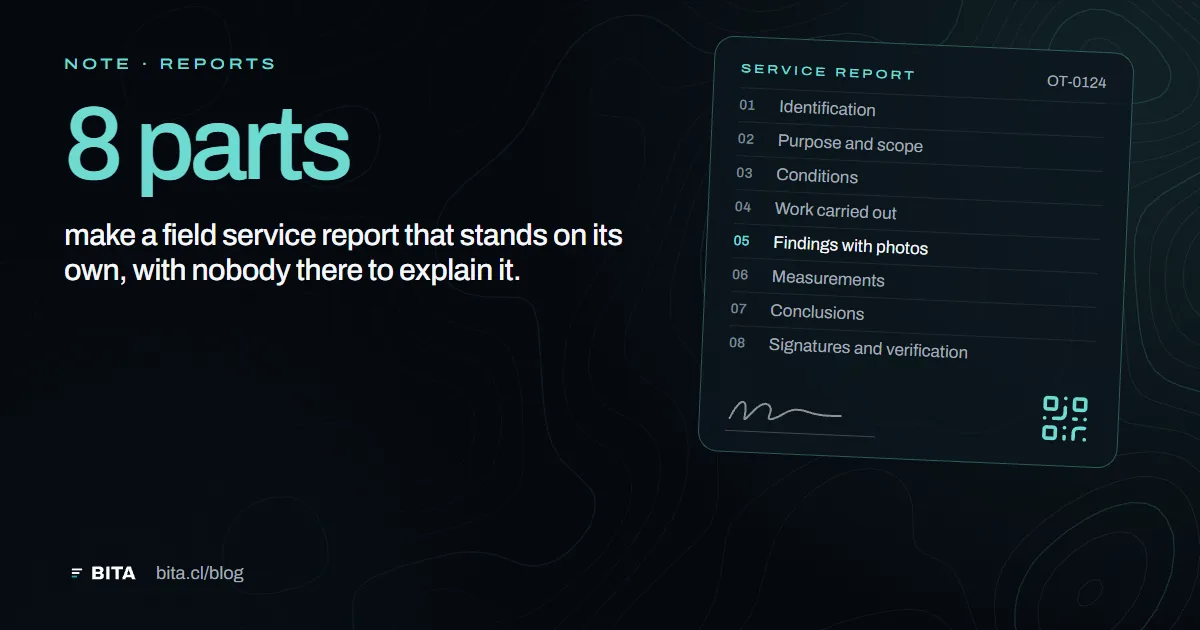
The structure of a field service report
Eight parts, in this order. If the client has its own format, use it; if not, this one works for almost any service:
- IdentificationThe report number, the client, the place (the farm site, the plant, the job site), the exact asset (the pen, the equipment, the line), the date and time of the work and who did it.
- Purpose and scopeWhat was requested and what was left out. «Inspection of the nets of pens 101 to 112» says more than «net inspection».
- ConditionsWhat affected the work: weather, visibility, tide, a piece of equipment that failed. It explains why something could not be checked.
- Work carried outWhat was done, in order, with the equipment or instruments used.
- FindingsEach observation on its own, with its location, its severity and its evidence. It is the part the client reads first.
- MeasurementsThe values with their units, the instrument and, where relevant, the reference value.
- Conclusions and recommendationsWhat the findings mean and what needs to be done, with deadlines where relevant.
- Signatures and verificationWho did the work and who received it, and how to check that the document is the original: a report number and, better still, a verification code.
How to write a finding people understand
A good finding says what was seen, exactly where, how serious it is and what evidence supports it, in one or two sentences.
Compare two ways of saying the same thing:
- Poor: «Damage observed on the net.»
- Good: «10 cm tear on the outer face of the net of pen 104, at 12 m depth. High severity: escape risk. Photo 7.»
The second can be located, repaired and checked; the first means calling to ask. Always use the same words for the same thing —a fixed severity scale, the same names for the faces of a net or for the equipment— and put the photo next to the finding, not in an appendix.
The most common mistakes
- Copying the previous reportThe date is changed and the name of last time's site or pen stays. It is the most common mistake and the one that damages trust the most.
- Photos without contextAn appendix of twenty photos that do not say what they show supports nothing.
- «All OK»If nothing was found, say so with the scope: what was checked and under what conditions. «No observations in the 12 pens inspected» is a result.
- The report date instead of the work dateWhat matters is when the work was done and seen, not when it was written up.
- Versions circulating by emailIf something has to be corrected, the new version should say so and the previous one should be identified. Otherwise the client ends up with three different PDFs and none of them is reliable.
Checklist before sending
- Does it have a report number and the date of the work?
- Is the scope clear: what was checked and what was not?
- Does each finding say where, how serious and which photo?
- Do the measurements have their units?
- Do the recommendations say what to do and when?
- Is it signed by whoever did the work and whoever received it?
- Can the recipient check that it is the original?
For the last point, see what makes a report traceable and verifiable.
The report nobody has to write
The way to avoid almost all these mistakes is not to write the report afterwards: record each finding on site, with its photo and its location, and let the report be built from that data in a fixed format. Then there is nothing to copy from the previous one and no photos to sort. It is what we do at BITA, and we tell the story in the hours lost after the job.
