
What is report traceability?
The traceability of a technical report is the ability to show where every piece of data in it came from: who recorded it, when, where, with what evidence, and what happened to the document after it was issued.
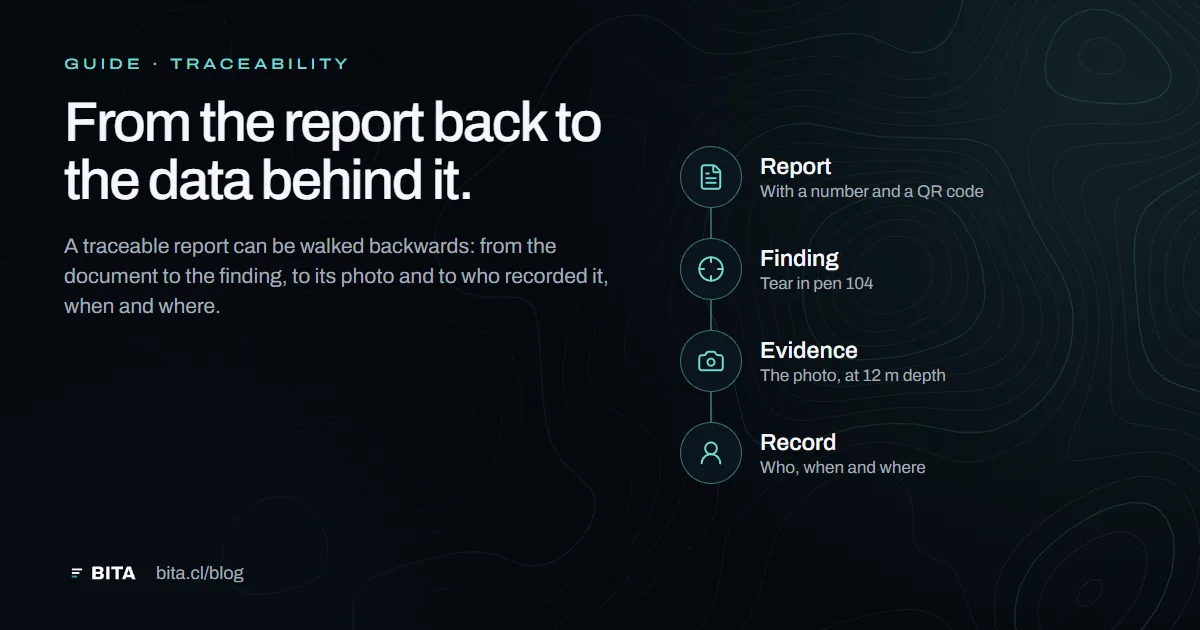
A traceable report is more than a well-presented PDF. It is the last link in a chain you can follow backwards: from the document to the finding, from the finding to the photo or measurement that supports it, and from there to the person, the place and the moment it was recorded.
It is document traceability applied to field work. Document traceability follows the history of the document: who created it, who changed it and whether it is still valid. A technical report's traceability adds the origin of every piece of data.
Why does it matter?
- Defend the work in an auditIt turns what was done into evidence you can show a client, an auditor or an authority, and every statement is backed by its record.
- Settle disagreements with the clientIf a finding or a measurement is disputed, nobody argues from memory: you go back to the record, the photo and whoever signed.
- Find the source of an errorWhen something fails, you know what was recorded, on which asset, when and by whom, and you fix the cause instead of the symptom.
- Follow each asset's historyInspections of the same pen, the same equipment or the same line can be compared over time, because each report stays linked to its asset.
- Prevent tampered documentsWhoever receives the report can check that it is the original and that it is still valid.
What a traceable report needs
Eight things you can check in any report, whoever issued it:
- A unique numberA number that never repeats in the company that issues it. Without one, two different documents can pass for the same.
- Who, when and whereThe name of whoever did the work, the date and time, the place and the exact asset: the pen, the equipment, the line or the structure.
- Evidence attached to each findingEach photo or measurement next to the finding it supports, not in a loose annex where nobody knows what it proves.
- Data recorded only onceThe report comes from the record made in the field. Every time someone copies data from a notebook or a spreadsheet into another document, an error can slip in.
- The signatures of those responsibleWhoever did the work and, when it applies, whoever received it. The signature says who answers for what the report states.
- A copy that doesn't changeOnce issued, the report isn't edited quietly. If it needs a correction, a new version is issued with its reason and the previous one stays archived.
- A code to verify itA QR or written code that lets anyone check, without an account, that the document is authentic.
- Its status in plain sightIf the report was voided, the verification has to say so, with its reason, so nobody uses it as if it were valid.
Signs that a report isn't traceable
- It's put together in Word or Excel and can be edited after it's sent without anyone noticing.
- The photos arrive by WhatsApp or in a separate folder, without saying which finding they support.
- The data is retyped by hand from the field notebook into the report.
- It has no number, or the same number appears on two documents.
- There's no way to know whether the PDF you have is the latest one or whether it was voided.
- Corrections replace the file without a trace of what changed or why.
How to check a report you received
- Find the codeIt's usually at the foot or on the cover of the report, next to a QR code.
- Open it where the document saysScan the QR with your phone's camera or type the code on the verification page the report points to. Reports issued with BITA are checked at bita.cl/en/verify.
- CompareCheck that the company, the document type, the number and the date match the report you have.
- Look at its statusA valid document counts; a voided one doesn't, even if the PDF is still going around.
If the report has no code, ask whoever issued it for the original record and the dated photos. If they don't have them, the report can't be checked.
How BITA handles it
BITA is a traceability platform for companies that do field work. What this guide asks for is part of everyday work in BITA:
- Recorded where it happensThe technician records findings, measurements and photos on a tablet or phone, linked to their asset. For treatment baths, training records and maintenance reports, also without signal.
- The report comes from the recordBITA builds the report with your company's brand, its number and the signatures each service requires, without copying data into another document.
- What's issued doesn't change quietlyA delivered work-order report is frozen. In ROV and net-cleaning records, a correction is a new version with the same number, and the previous one stays archived.
- Checked with a codeInspection, maintenance, bath, ROV, net-cleaning, laboratory test, training and vaccination reports carry a QR code anyone can verify, with its status today.
- Every asset with its historyEach finding stays on its asset (the pen, the line, the structure), so the next inspection can be compared with the last one.
