
What changed on 26 April 2026
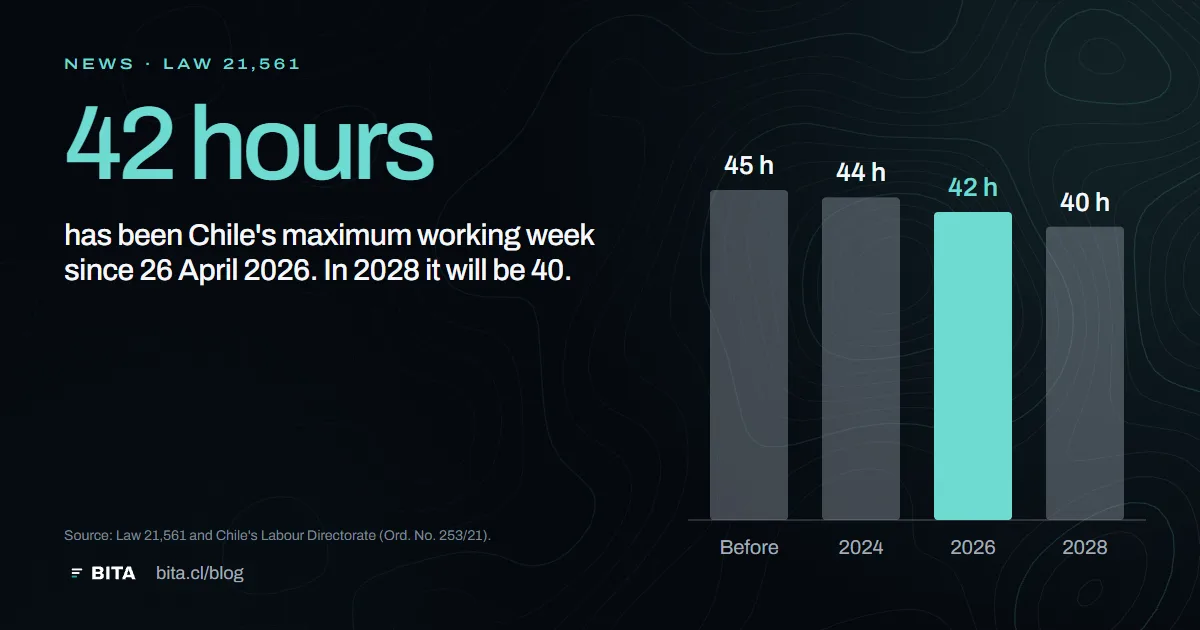
Since 26 April 2026, the maximum ordinary working week in Chile is 42 hours. It is the second stage of Law 21,561: the first cut it from 45 to 44 hours in 2024 and the last will bring it to 40 hours on 26 April 2028.
- 26 April 2024From 45 to 44 hours a week.
- 26 April 2026From 44 to 42 hours a week: the current stage.
- 26 April 2028From 42 to 40 hours a week.
The law forbids the reduction from lowering pay: fewer hours are worked for the same salary.
How is the two-hour cut applied?
First comes the agreement between the company and its workers. Without one, the Labour Directorate set a rule: the cut is made at the end of the working day, on different days of the week.
- Five-day weekOne hour less at the end of the working day, on two different days.
- Six-day weekFifty minutes less at the end of the working day on two different days, plus twenty minutes on a third day.
Without an agreement, the employer chooses the days. That is what the Labour Directorate's ruling Ord. No. 253/21 of 16 April 2026 sets out, partly reconsidering the criterion the Directorate itself had given in February (Ord. No. 142/09).
If the company works special shifts authorised by the Labour Directorate, such as an exceptional working-hours system, it should check with the Directorate or a lawyer how the cut applies to it.
What did not change: the overtime rules
Overtime is still limited to two hours a day, agreed in writing and paid at a premium of at least 50%. What changed is when it starts counting: with 42 hours, earlier.
An hour that was within the working week at 44 hours can be overtime at 42. That is why the cut shows first where the working day was already tight: in jobs that end when the tide, the daylight or the client's window runs out, and still have paperwork pending afterwards.
Law 21,561 also added an alternative to payment: the parties can agree in writing that overtime is compensated with additional days of leave, up to five working days a year. Each hour of overtime earns an hour and a half of rest; the days are used within the following six months, with 48 hours' notice, and if they are not used, they are paid.
What it means for a field service company
In a company that works at fish farms, plants or job sites, the working day does not go only into the work: it goes into travel, into waiting for the window and into the paperwork afterwards. With two hours less a week, there are three places to look:
- The paperwork after the jobIt is the easiest time to win back, because it adds nothing for the client: the report put together at night from the day's notes and photos. We explain it in the second shift.
- How long each job really takesWith less margin, it matters. If field records carry the start and finish times set by the system, you plan with data rather than memory. (They do not replace the attendance record required by law.)
- Shift planningIf a typical job already filled the whole working day, with 42 hours shifts must be split differently or more people added. It is worth solving before April 2028, when the week drops to 40.
This is general information, not legal advice. For your case, ask the Labour Directorate or your lawyer.
What comes next: 40 hours in 2028
The last stage of the law cuts the working week to 40 hours on 26 April 2028: two hours less per week and per person. What a company sorts out now —how it records, how long it takes to issue a report, how much paperwork is done outside working hours— is what it will have when that date arrives.
Sources
- Dirección del Trabajo, Ord. No. 253/21, 16 April 2026: how to apply the cut from 44 to 42 hours (in Spanish).
- Dirección del Trabajo: the 40-hour law microsite (in Spanish).
- Dirección del Trabajo: compensating overtime with additional days of leave (in Spanish).
- Ministry of Labour: compensating overtime with days of rest (in Spanish).
- Dirección del Trabajo, Ord. No. 771, 2024: overtime (in Spanish).
- Library of the National Congress: Law 21,561 (in Spanish).
